[EN]Providing educational materials for rural schools in Kenya
By Sean Hogan
Past Governor of Rotary District 5050 (British Columbia, Canada; Washington, USA)
Member of the Rotary Club of Pacific Northwest Passport
Rotary has been a big part of my life since I joined at age 27. It’s given me friends and opportunities that I would never have had otherwise, including serving as District Governor in 2012-13 (Peace Through Service). One of those opportunities was to be part of Rotary service projects in Kenya, starting in 2009.
The project we’ve been doing in Kenya is called ARES (the African Ruggedized Education System), and our philosophy is that if you truly want to change the world, you begin by educating the children.
Bonnie Sutherland joined the Rotary Club of North Delta, British Columbia, Canada after retiring as a teacher. She had been working in Africa since 1992 and invited my wife and I to join her on one of her Rotary projects. Bonnie’s NGO, Afretech Aid Society, works with Rotary clubs and Rotary World Help to ship libraries, computers, medical equipment and more to Africa and elsewhere.
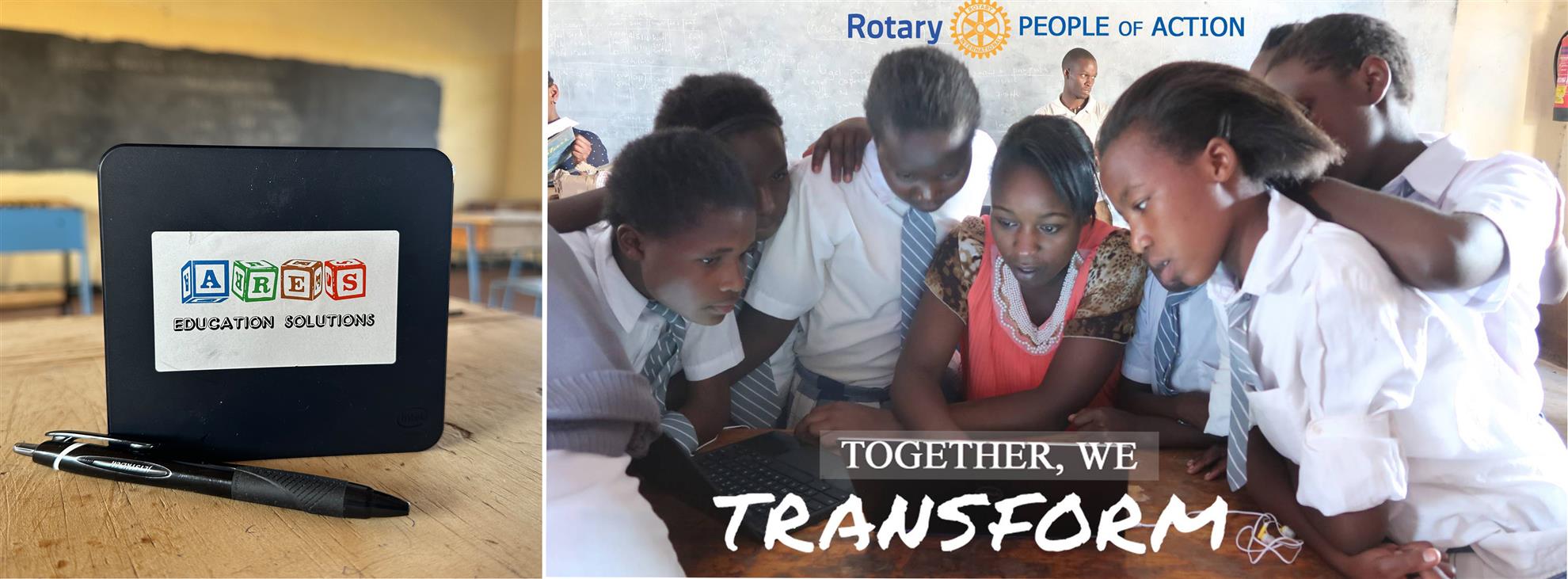
Mark Knittel, a member of the Rotary Club of Bellingham, Washington, USA, joined us on a trip in 2011. Mark created a small server with educational content from pre-school to post-grad, including thousands of video tutorials and books, the Khan Academy, STEM resources, TED Talks, Wikipedia, textbooks, and much, much more.
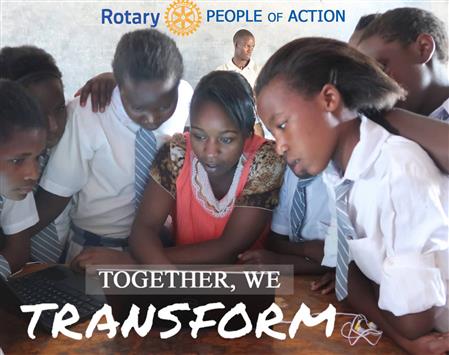
The ARES project focuses on remote, rural schools where children and their teachers have never even touched a computer. Remote rural schools often have limited access to books, paper, and writing materials, as well as intermittent power and no internet access.
An ARES server is installed in each school, along with laptops, a projector, and speakers and a mesh network to connect all classrooms in the school to the ARES server.
We have now provided ARES servers and computer labs to around 100 schools in Kenya, thanks to generous support by Rotary Clubs, Rotarians and The Rotary Foundation (Canada).
We return every year and for each of those years we have received Rotary District Grants. In 2020 we were able to add 15 new schools with the help of a Rotary Global Grant. Four local Rotary clubs in BC and Washington each donated $5,000 USD which, with matching grants from Rotary and the Government of Canada, provided funding of over $129,000.
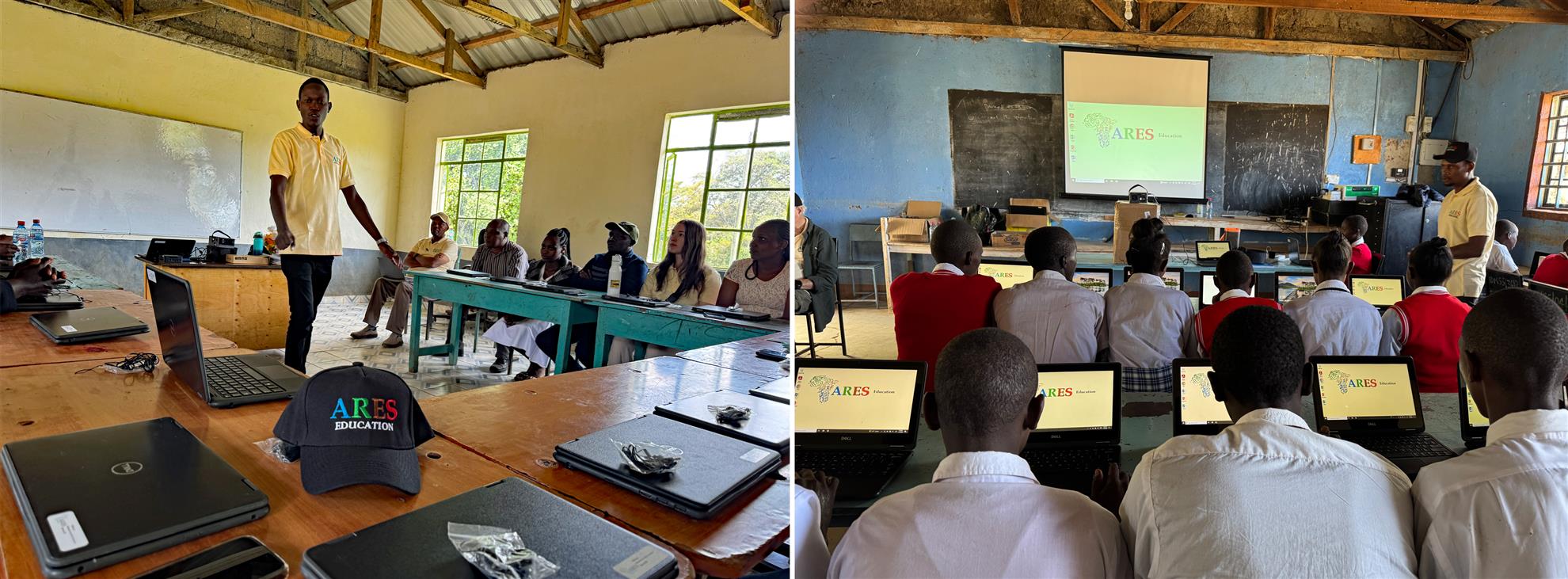
We install an ARES server in a school along with 20 laptops, a projector, speakers, earplugs, and mesh network units to share the wireless access throughout. Everything runs on rechargeable batteries, so if the school loses power, the system still operates. The project also provides training and support for teachers through local teams to ensure sustainability.
Our most recent visit in January 2025 added five more schools thanks to the donations of three Rotary clubs and another Rotary District Grant. Our team included Rotarians and supporters, each of whom paid their own way so that all proceeds go directly to the benefit of the schools, students and teachers.
The project is a partnership. The schools provide the room for the computer lab, a secure storage locker, electrical connections, tables and chairs. We work with local Kenyan partners, such as the Rotarian led Computers for Schools Kenya, local conservancies and others. The project employs local IT support workers who continue to maintain, teach and support throughout the school year. A significant part of the success of the project is the teacher training and engagement.
It is a life changing experience for us, as well as for the people that we help.
To use a common Swahili saying – Asante Sana. Thank you.
[FR]Fournir du matériel éducatif aux écoles rurales du Kenya
Par Sean Hogan
Ancien gouverneur du District Rotary 5050 (Colombie-Britannique, Canada; Washington, États-Unis)
Membre du Rotary Club of Pacific Northwest Passport
Le Rotary occupe une grande place dans ma vie depuis que j’en suis devenu membre à 27 ans. Il m’a apporté des amis et des occasions que je n’aurais jamais eus autrement, notamment celle de servir comme gouverneur de district en 2012-2013 (La paix par le service). L’une de ces occasions a été de participer à des projets de service du Rotary au Kenya, à partir de 2009.
Le projet que nous menons au Kenya s’appelle ARES (African Ruggedized Education System, ou système d’éducation robuste pour l’Afrique), et notre philosophie est simple : si l’on veut vraiment changer le monde, on commence par instruire les enfants.
Bonnie Sutherland s’est jointe au Club Rotary de North Delta, en Colombie-Britannique (Canada), après avoir pris sa retraite de l’enseignement. Elle travaillait en Afrique depuis 1992 et nous a invités, ma femme et moi, à participer à l’un de ses projets rotariens. L’ONG de Bonnie, Afretech Aid Society, collabore avec des clubs Rotary et Rotary World Help pour expédier des bibliothèques, des ordinateurs, de l’équipement médical et bien plus en Afrique et ailleurs.
Mark Knittel, membre du Club Rotary de Bellingham, dans l’État de Washington (États-Unis), s’est joint à nous lors d’un voyage en 2011. Mark a créé un petit serveur rempli de contenu éducatif, du préscolaire aux études supérieures, dont des milliers de tutoriels vidéo et de livres, la Khan Academy, des ressources en sciences, technologie, ingénierie et mathématiques, des conférences TED, Wikipédia, des manuels scolaires et bien plus encore.
Le projet ARES cible des écoles rurales éloignées où les enfants et leurs enseignants n’ont jamais touché à un ordinateur. Ces écoles ont souvent un accès limité aux livres, au papier et au matériel d’écriture, une alimentation électrique intermittente et aucun accès à Internet.
Un serveur ARES est installé dans chaque école, avec des ordinateurs portables, un projecteur, des haut-parleurs et un réseau maillé qui relie toutes les classes de l’école au serveur ARES.
Nous avons maintenant fourni des serveurs ARES et des laboratoires informatiques à une centaine d’écoles au Kenya, grâce au généreux soutien de clubs Rotary, de Rotariens et de la Fondation Rotary (Canada).
Nous y retournons chaque année et, chaque année, nous avons reçu des subventions de district du Rotary. En 2020, nous avons pu ajouter 15 nouvelles écoles grâce à une subvention mondiale du Rotary. Quatre clubs Rotary locaux de la Colombie-Britannique et de l’État de Washington ont chacun donné 5 000 $ US, ce qui, avec les fonds de contrepartie du Rotary et du gouvernement du Canada, a permis de réunir plus de 129 000 $.
Nous installons dans chaque école un serveur ARES, 20 ordinateurs portables, un projecteur, des haut-parleurs, des écouteurs et des unités de réseau maillé pour partager l’accès sans fil dans tout l’établissement. Tout fonctionne avec des batteries rechargeables : si l’école perd le courant, le système continue de fonctionner. Le projet offre aussi de la formation et du soutien aux enseignants par l’entremise d’équipes locales, afin d’en assurer la durabilité.
Notre plus récente visite, en janvier 2025, a permis d’ajouter cinq écoles grâce aux dons de trois clubs Rotary et à une autre subvention de district du Rotary. Notre équipe comprenait des Rotariens et des sympathisants qui ont tous payé leurs propres frais, afin que la totalité des fonds profite directement aux écoles, aux élèves et aux enseignants.
Le projet est un partenariat. Les écoles fournissent la salle du laboratoire informatique, une armoire de rangement sécurisée, les branchements électriques, les tables et les chaises. Nous travaillons avec des partenaires kényans, comme Computers for Schools Kenya, un organisme dirigé par des Rotariens, des réserves naturelles locales et d’autres encore. Le projet emploie des techniciens informatiques locaux qui assurent l’entretien, l’enseignement et le soutien tout au long de l’année scolaire. La formation et l’engagement des enseignants sont une part importante du succès du projet.
C’est une expérience qui change la vie, pour nous comme pour les gens que nous aidons.
Comme le dit une expression swahilie courante : Asante Sana. Merci beaucoup.